The Physics of Compression: Why the ~30% Gradual Reduction Rule Matters in Noodle Engineering
Introduction
The Physics of Compression: Why the ~30% Gradual Reduction Rule Matters in Noodle Engineering
In industrial noodle manufacturing, the temptation is always to force production speed. However, when handling the delicate protein structure of wheat dough, mechanical force must respect the laws of rheology.
At NoodleMachinePro, we implement an approximately 30% thickness reduction per pass (R ≈ 30%) as an uncompromising engineering processing standard. Rather than crushing dough in aggressive, high-deformation stages, distributing compression across calibrated roller pairs acts as “mechanical yoga” for the gluten matrix. It progressively aligns protein fibrils, preserves natural wheaty aromatics, and enables true Clean Label production without synthetic dough conditioners.
1. Clean Label Integrity: Physical Alignment Over Chemical Additives
Many commercial manufacturers rely on chemical strengtheners, emulsifiers, or synthetic conditioners. In most cases, these additives are not introduced by choice—they are bandages required to patch the structural damage caused by aggressive machinery that crushes dough by 50% to 70% in a single pass.
- Mechanical Yoga for Gluten Fibrils: Limiting reduction to ~30% per stage guides glutenin and gliadin polymers into an unbroken longitudinal matrix without rupturing their intermolecular disulfide bonds.
- 100% Additive-Free Elasticity: Because the natural protein matrix remains mechanically intact, there is zero reliance on chemical texturizers. Your factory can produce export-grade, clean-label noodles using solely flour, water, salt, and kansui.
- Elimination of “Dough Memory”: Uniform micro-deformation provides continuous stress relaxation, preventing finished noodles, dumpling skins, or empanada sheets from shrinking, curling, or snapping back after cutting.

2. The Friction-Heat Problem: Protecting the Natural Wheaty Aroma
A fundamental law of mechanical physics dictates that kinetic deformation generates friction heat. When an industrial roller forces high dough volume through an excessively tight nip, shear friction creates intense instantaneous heating.
- The 28°C Thermal Ceiling: If dough temperature exceeds 28°C during continuous sheeting, wheat proteins begin premature thermal denaturation, and delicate volatile flavor esters evaporate.
- The 30% Thermal Solution: Gentle, distributed compression minimizes contact friction. Dough sheets remain cool, dense, and translucent, locking in authentic grain aroma and producing a smooth, glassy bite.
3. The Complete Processing Sequence: Synergizing with R-C-R
The 30% gradual reduction standard does not operate in isolation; it is the precision downstream phase of our proprietary R-C-R processing logic:
Mixing → R1 → Compound Lamination → R2 → Progressive Reduction (~30%) → Cutting
- R1 (Granular Pre-Forming Rest): Facilitates uniform flour hydration at the microscopic particle level.
- Compound Lamination: Merges multiple dough webs under uniform linear pressure to create an interleaved, multi-layered gluten matrix (up to dozens or even 200+ micro-layers).
- R2 (Sheet Maturation & Stress Relaxation): Relieves internal mechanical strain accumulated during compounding, stabilizing the dough slab before progressive thinning.
- Progressive Reduction: Systematically thins the matured sheet to exact target thickness along a single vector, preserving the interleaved strata developed during compounding.
4. Mathematical Model: The 6-Pass Progressive Reduction Sequence
To maintain continuous elasticity and uniform tensile recovery, sheet thickness is reduced across each nip according to the formula:
Next Thickness ≈ Previous Thickness × 70%
| Sheeting Stage | Inlet Gauge (Hin) | Outlet Gauge (Hout) | Reduction Ratio (ΔH / Hin) | Primary Engineering Function |
| Pass 1 (Post-R2) | 10.0 mm | 7.0 mm | 30.0% | Macro-compaction; air pocket elimination |
| Pass 2 | 7.0 mm | 4.9 mm | 30.0% | Primary gluten fibril orientation |
| Pass 3 | 4.9 mm | 3.4 mm | 30.6% | Intermediate density consolidation |
| Pass 4 | 3.4 mm | 2.4 mm | 29.4% | Micro-layer laminar stress relief |
| Pass 5 | 2.4 mm | 1.7 mm | 29.2% | Pre-slitter calibration |
| Pass 6 (Final) | 1.7 mm | 1.2 mm | 29.4% | Target gauge delivery |
5. Machine Architecture: Continuous Automation vs. Batch Sheeting
5.1 Continuous Multi-Stage Industrial Lines (5 to 9 Dedicated Stages)
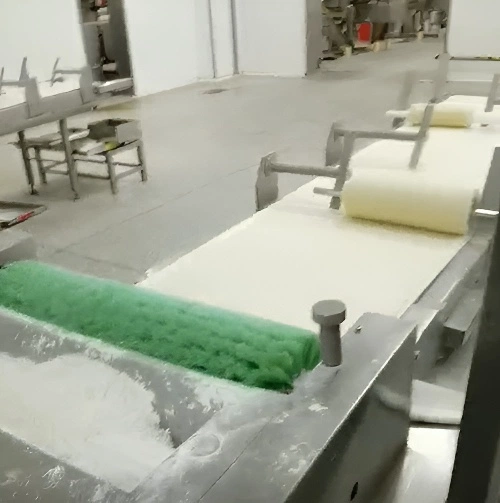
- Unidirectional Linear Sheeting: Unlike the compounding stage where layers are combined, the final thinning section draws the sheet along a strictly forward vector. The sheet passes through each dedicated roller pair once, eliminating surface moisture loss and cumulative friction heat.
- High Output Scalability: VFD-synchronized roller speeds automatically match the continuous longitudinal expansion of the thinning sheet, supporting output capacities from 300 kg/h to over 650 kg/h without structural tearing. Maintaining this sub-micron thickness discipline under multi-ton dynamic loads requires an unyielding, heavy-duty steel frame to eliminate roller deflection across multi-shift continuous runs.
- Recommended For: Automated central factories, high-volume noodle manufacturing plants, and industrial fresh/frozen noodle facilities. (Explore our turnkey Automatic Fresh Noodle Production Line for complete multi-stage layout specifications.)
5.2 Compact Multi-Pass Sheeters (Single or Dual Adjustable Rollers)
- Manual Gap Adjustment: The 30% reduction sequence can mechanically be achieved on smaller units by feeding the sheet through, adjusting the gap dial, and returning the sheet for subsequent passes.
- The Operational Trade-off: While mechanically feasible, this method introduces operator dependency, cycle pauses, and uneven ambient drying during manual handling.
- Recommended For: Pilot test kitchens, culinary laboratories, and small specialty artisan restaurants. (For standalone batch workflows, see our 3-Stage & 5-Stage Commercial Noodle Machines.)
6. Precision Execution: The SIKO Digital Calibration Standard
A theoretical reduction curve is meaningless without mechanical repeatability. In high-speed industrial lines, an uncalibrated gap discrepancy of merely 0.3 mm on a 1.7 mm pass spikes instantaneous deformation past 47%, tearing sheet margins and clouding cooking broth.
NoodleMachinePro integrates German-engineered SIKO digital handwheels across all progressive reduction stands:
- Surgical Mechanical Accuracy: Eliminates operator guesswork, vernier misreads, and sensory dial-turning.
- Batch Repeatability: Plant engineers can lock verified recipe coordinates into production SOP charts, allowing operators across different shifts to reproduce the exact ~30% reduction profile instantly.

FAQ: Precision Sheeting Science
📌 Let’s Assist You
Selecting the correct number of rolling stages, roller diameters, and surface metallurgy requires a deep understanding of flour rheology and factory capacity goals. Contact our engineering team with your dough hydration profile and target output to receive a customized roller reduction schedule and production line proposal.
Email directly: info@NoodleMachinePro.com


Talk to Zhou on Wechat
Scan the code to add
Or, if you prefer, simply fill out our Contact Form and tell us your production goals.
We’ll get back to you with a tailored recommendation within 24 hours.