Engineering Throughput: The 200kg/h Fresh Noodle Production Blueprint
Introduction
In industrial fresh noodle manufacturing, the greatest challenge is balancing volume with textural integrity. High-speed production often leads to over-stressed dough and broken protein strands. This case study analyzes how a customized Fresh Noodle Production Line↗—featuring 4-stage rolling and integrated VFFS packaging—achieves a steady 100–200 kg/h output while strictly adhering to the R-C-R (Resting-Compounding-Resting) philosophy.
By optimizing the workflow for only three operators, this system proves that industrial scale does not have to mean a compromise in Gluten Network quality.
Phase 1: Precision Mixing & Pre-R1 Hydration
Equipment: Conventional Dough Mixer (50kg/Batch) The process begins with low-speed mixing to create “snowflake” granules. To maximize floor efficiency, the hydrated dough is discharged into three stainless steel containers.
- The Engineering Logic: By dividing the batch, we facilitate the First Resting Stage (R1). This 3–5 minute pause allows for “Synchronized Hydration” before the dough ever hits a roller, ensuring a uniform protein foundation.
👉 Also read Why Dough Resting Matters in Noodle Making?↗

Phase 2: Compounding & Dozens of Layer Lamination
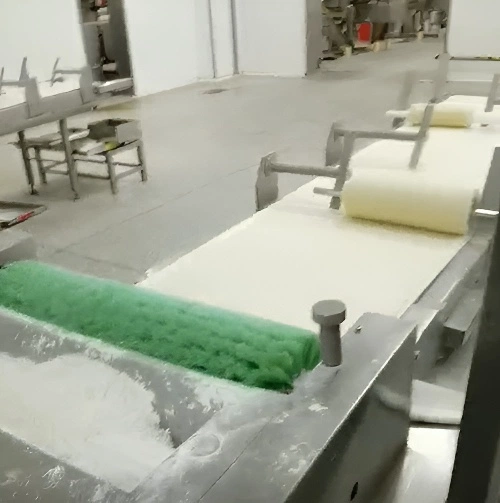
Equipment: First Roller Group (300mm Width) The crumbly dough is transformed into a composite sheet through Multi-Layer Lamination.
- The Technical Goal: We don’t just flatten the dough; we “weave” it. By creating dozens of layers at a 10mm initial thickness, we establish a robust multi-directional Gluten Network that provides the “bite” required for premium Japanese Ramen↗ and fresh Chinese noodles.

Phase 3: Progressive Reduction & R2 Stress Relaxation
To prevent the dough from “shattering,” we apply the 30% Gradual Reduction Rule across three subsequent roller groups, integrated with a strategic resting buffer:
- Intermediate Reduction: The sheet is reduced to 4.5mm.
- R2 Integrated Resting: The sheeted dough is coiled onto rolls (≈70kg each) and placed on a custom resting rack for 10–15 minutes. This is critical Stress Relaxation. It allows the elastic tension built up during lamination to dissipate before the final thinning.
- Final Calibration: The 3rd and 4th roller groups finish the sheet to a precise 1.2mm–1.5mm.
👉 Also read how to strength gluten network during rolling?↗
Phase 4: Precision Cutting & Automated VFFS Packaging
Equipment: Integrated Slitter & VFFS Vertical Packaging Machine↗ The stabilized dough sheet enters the final stage:
- Customized Slitting: The line features four interchangeable cutters, allowing for rapid switches between round and flat noodle profiles.
- VFFS Integration: Noodles are automatically dusted, measured, and sealed in pouches. This integration eliminates the bottleneck of manual bagging, allowing the 200 kg/h flow to remain uninterrupted.
Operational Efficiency: The 3-Man Protocol
Industrial automation allows this high-output line to be managed by minimal staff:
- Operator A: Manages mixing and primary lamination (Phase 1 & 2).
- Operator B: Oversees reduction rolling and the R2 resting rack (Phase 3).
- Operator C: Manages the VFFS packaging output and final boxing.
Frequently Asked Questions
📌 Let’s Assist You
Build the Line That Fits Your Reality. At NoodleMachinePro, we don’t sell “off-the-shelf” boxes. We engineer throughput. Whether you need to integrate VFFS packaging or maximize a small factory footprint, our 4-stage lines are customized to your recipe and your goals.
Email directly: info@NoodleMachinePro.com


Talk to Zhou on Wechat
Scan the code to add
Or, if you prefer, simply fill out our Contact Form and tell us your production goals.
We’ll get back to you with a tailored recommendation within 24 hours.