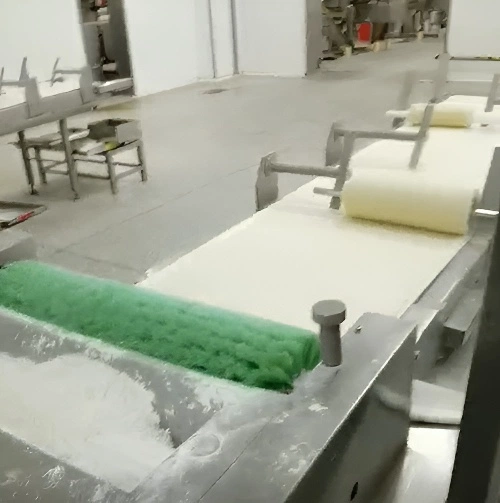
R-C-R Noodle Processing Logic: How Resting and Compound Lamination Develop Noodle Structure
Introduction
In industrial noodle manufacturing, dough transformation cannot be rushed by mechanical brute force. The physical sequence linking mixing, hydration resting, compound lamination, and final thinning directly governs the formation of the gluten matrix, continuous sheeting stability, and finished noodle elasticity.
At NoodleMachinePro, our R-C-R (Resting–Compounding–Resting) architecture is the foundational engineering framework for producing high-tensile, additive-free noodles:
R1 → C → R2
- R1: Stabilizes bound moisture across granular particles without developing premature dough clumping.
- C (Compound Lamination): Builds an interleaved, multi-layered matrix through continuous parallel folding and compression.
- R2: Dissipates high internal shear stresses accumulated during lamination before the sheet enters final thinning.
Understanding R-C-R is not merely about tracking process stages—it is about orchestrating the rheological transitions between them.
1. The Rheological Imperative: Structure Over Mechanical Compression
Wheat-based dough relies on the interaction between gliadin (extensibility) and glutenin (elasticity). However, raw protein content alone does not guarantee a resilient noodle. The microscopic layout of these protein chains is dictated by mechanical deformation:
| Processing Variable | Direct Structural Impact |
| Hydration & Mixing Action | Particle surface saturation vs. core dry centers |
| R1 Granular Maturation | Free water diffusion into bound protein structures |
| Compound Lamination (C) | Multi-axial grain alignment and laminar stratification |
| R2 Sheet Relaxation | Elimination of internal strain hardening and dough memory |
| Progressive Thinning | Gradual gauge reduction without micro-shear fractures |
Applying high-pressure compression to unconditioned dough ruptures the developing matrix. Industrial noodle manufacturing must be engineered as an end-to-end metallurgical and rheological sequence rather than a series of standalone rollers. Maintaining this sub-micron thickness discipline across continuous multi-shift production requires massive structural rigidity and deflection-free machine frames that isolate delicate gluten ribbons from drive-train vibration and frame flex.

2. Phase 1 — R1: Low-Speed Granular Maturation
The R1 phase commences immediately after discharge from the mixer. At this point, the dough consists of loose, high-surface-area granules rather than a solid mass.
R1 is an active, low-speed maturation process rather than a static rest. A slow-speed ribbon trough (running at 5 to 8 RPM) gently agitates the bed:
- Capillary Water Migration: Allows moisture to penetrate deeply from particle peripheries into inner starch chains.
- Loose Aggregation: Prepares granules to knit together cleanly under the intake rollers without requiring excessive compressive force.
Achieving uniform granules requires dedicated mixing mechanics. For low-hydration formulations, our Wolf-Tooth Dough Mixer uses wedge-shaped shearing blades to create loose snowflake crumbs prior to R1.

3. Phase 2 — C: Engineering the Multi-Layer Matrix
The defining core of the R-C-R framework is Compound Lamination (C). While a standard noodle line forces a single continuous sheet directly into reduction rollers, compound lamination systematically interleaves separate sheets:
- Single-Layer Processing: Dough $\to$ Single Web $\to$ Progressive Reduction $\to$ Final Noodle. (Susceptible to transverse tearing and low boiled firmness).
- Double-Sheet Compounding: Two separate webs merged into one. (Standard commercial baseline).
- Continuous Multi-Layer Lamination: Through continuous web-stacking and re-pressing, the line folds and interweaves incoming webs into dozens to 100+ micro-layers.
Mechanical Strength Without Synthetic Conditioners
By folding and cross-compressing dough sheets, gluten chains align multi-axially rather than strictly unidirectionally. This dense, stratified matrix provides structural springiness (Q-彈) and prevents starch leaching during boiling, eliminating the commercial need for chemical firming agents or synthetic conditioners.
3.1 Why Does the Layer Structure Matter?
Compound lamination is not simply another method of making dough thinner. Its purpose is to develop a more complex internal dough structure before final reduction.
A simplified comparison is:
Single-layer process
Dough → 1-layer sheet → progressive reduction → final noodle
Two-layer process
Two sheets → compound pressing → 2-layer sheet → progressive reduction → final noodle
Compound-lamination process
Dough sheet → repeated compound pressing → dozens of layers → R2 → progressive reduction → final noodle
The final noodles may look similar from the outside, but their internal gluten network is different.
For wheat-based noodles, this matters because the gluten network develops within the dough structure. Controlled compounding and pressing can create a more integrated and densely developed structure before the final thinning process.
This can contribute to the firmness, elasticity, and springy bite that manufacturers often seek in premium fresh noodles, ramen, fresh pasta, and other wheat-based noodle products.
3.2 Structure Rather Than Additives
Noodle texture is influenced by flour, hydration, mixing, resting, mechanical processing, and cooking.
Compound lamination provides a mechanical method for developing dough structure rather than relying primarily on formulation changes to create a stronger bite.
When correctly matched to the flour and product specification, the process can help manufacturers pursue a more elastic and structured noodle through processing itself, without making texture-enhancing additives the primary solution.
The objective is not to claim that every noodle formulation requires no additives. It is to develop as much of the desired structure as possible through appropriate flour selection and controlled processing.
3.3 Layer Count as an Engineering Parameter
The required layer count is not the same for every product.
A standard compound-lamination configuration can create dozens of layers. Where a customer requires a substantially higher layer count, additional compounding roller groups can be incorporated into the machine design.
A system designed for 100+ layers, for example, can use additional compounding stages to repeat the process before the final resting and reduction stages. The layer structure is therefore a custom engineering parameter, determined by the customer’s noodle specification, desired texture, production capacity, and process requirements.
4. Phase 3 — R2: Dissipating Strain Hardening and Dough Memory
R1 and R2 serve fundamentally different rheological purposes:
- R1 (Pre-Forming): Operates on loose granules to complete liquid absorption and support gentle physical aggregation.
- R2 (Post-Lamination): Operates on a dense, fully compressed continuous sheet.
During the C stage, intense roller pressure induces significant strain hardening (work hardening) within the protein network. If fed directly into progressive reduction passes, this internal tension causes micro-fractures, edge ruffling, and severe longitudinal shrinkage after cutting (“dough memory”).
R2 provides a continuous, temperature-monitored intermediate conveyor envelope:
Maturation Duration: Ranging from 20 minutes to over an hour depending on flour protein strength, water hardness, and room ambient conditions.y, hydration, processing conditions, and local market requirements.
Disulfide Bond Reorganization: Relieves internal shear stress while retaining the multi-layer laminar matrix.

5. Transition to Progressive Thinning: The ~30% Reduction Rule
Once internal stress has dissipated during R2, the sheet transitions smoothly into the high-speed thinning train.
To safeguard the delicate 100-layer architecture constructed during compounding, thickness reduction across each subsequent nip is governed by our approximately 30% gradual reduction rule:
Thicknessₙ ≈ Thicknessₙ₋₁ × 0.70
Distributing compression across dedicated rolling pairs prevents excessive friction heating (keeping temperatures safely below 28°C) and prevents layer delamination.
6. Line Scalability: Customizing R-C-R into Advanced R-C-C-C-R Configurations
R-C-R represents the baseline processing logic for industrial quality. For demanding specialty formulations—such as ultra-elastic fresh noodles or premium laminated wrappers—the core R-C-C-C-R logic scales modularly into extended architectures:
R1 → C1 → C2 → C3 → R2 → Reduction
In an automated Custom Noodle Production Line, the physical footprint, roller diameters, resting conveyor dwell times, and VFD line synchronization must be calculated during the initial CAD architecture. Multi-layer compounding cannot simply be retrofitted onto an existing single-pass machine; it requires deliberate integration of mechanical drive speeds and dough relaxation geometry.
7. FAQ: The R-C-R Standard
📌 Build Your Processing Line Around Noodle Rheology
A high-quality industrial noodle is not created by pressure alone.
It is created by controlling what happens to the dough at each stage:
Mixing → R1 → Compound Lamination → R2 → Progressive Reduction → Cutting
- R1 supports initial hydration.
- Compound lamination develops the internal dough structure.
- R2 gives that developed structure time to relax and stabilize.
Achieving exceptional bite, shelf-life stability, and clean-label purity requires an integrated production system engineered around your flour’s unique rheological profile. Contact our engineering team with your flour specifications and capacity targets to design a tailored R-C-R or extended multi-lamination line layout.
Email directly: info@NoodleMachinePro.com


Talk to Zhou on Wechat
Scan the code to add
Or, if you prefer, simply fill out our Contact Form and tell us your production goals.
We’ll get back to you with a tailored recommendation within 24 hours.