The Physics of Texture: Rice Noodle vs. Wheat Noodle Manufacturing on an Industrial Scale
Introduction
In the global food processing landscape, the categorization of pasta and noodle products often suffers from semantic and engineering ambiguities. A critical linguistic and technical distinction must be established: Rice Noodles are fundamentally distinct from Wheat Noodles. From a food engineering standpoint, referring to rice noodles as “rice noodle noodles” or conflating their production mechanics with wheat-based matrices represents a profound misunderstanding of carbohydrate chemistry and polymer rheology.
For industrial manufacturers, food plant directors, and procurement engineering teams, selecting the appropriate turnkey processing asset requires an exact comprehension of how different raw materials respond to mechanical stress, thermal parameters, and hydration curves. This technical analysis deconstructs the structural, thermodynamic, and mechanical divides between wheat-based lamination and rice-based extrusion systems.
1. The Molecular Divide: Gluten Matrix vs. Starch Gelatinization
The core scientific variance between wheat noodles and rice noodles resides in the presence or complete absence of structural protein networks at the macromolecular level.
1.1 Wheat Noodles: The Viscoelastic Gluten Framework
Wheat flour contains storage proteins—specifically gliadin and glutenin. Upon hydration and application of mechanical shear during mixing, these proteins cross-link via disulfide bonds to form a complex, three-dimensional Viscoelastic Gluten Matrix. This matrix acts as a continuous, elastic envelope that traps starch granules. The structural integrity, tensile strength, and characteristic “bite” (al dente texture) of wheat noodles depend entirely on the strength of this protein network. The rheological formula governing gluten elasticity can be modeled through mechanical stress-relaxation responses under controlled deformation thresholds.
1.2 Rice Noodles: Total Reliance on Starch Gelatinization
Conversely, rice is inherently Gluten-Free. Rice flour lacks the cohesive storage proteins necessary to build an elastic matrix through mere hydration and kneading. Therefore, the production of fresh rice noodles must rely entirely on an alternate physical phenomenon: Starch Gelatinization.
Rice starch, dominated by amylose and amylopectin polymers, must be subjected to precise thermal energy in the presence of water. This inputs thermal trauma sufficient to disrupt the crystalline structure of the starch granules, forcing the amylose chains to leach out and form a viscous, irreversible aqueous gel upon cooling. Thus, while wheat engineering focuses on preserving protein strands, rice engineering focuses on controlling polymer crystallization curves.

2. Mechanical Stress Lamination vs. Thermal Screw Extrusion
Because the molecular binding mechanisms are completely inverted, the mechanical forces required to shape the dough sheet are fundamentally distinct, requiring specialized industrial configurations.
2.1 Flour Noodle Lamination: The 30% Reduction Rule
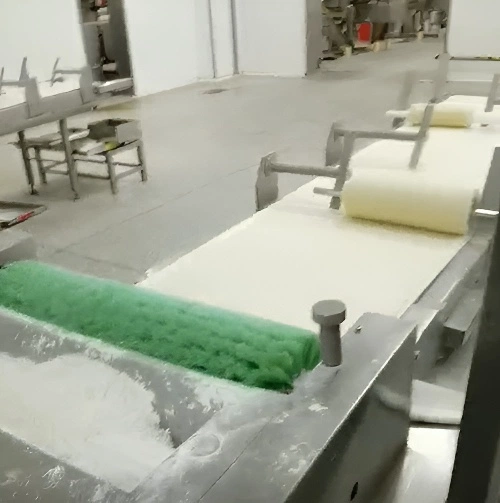
Industrial flour noodle processing demands highly progressive, non-destructive mechanical stress. After the initial mixing stage creates optimal “snowflake” granules, the dough mass is conveyed into a multi-stage compounding and reduction roller system.
Here, the critical engineering threshold is the 30% Reduction Rule: the dough sheet’s thickness must never be reduced by more than 30% in a single pass through the progressive roller gating.
Exceeding this mechanical threshold induces severe frictional heat and structural shear stress, resulting in Mechanical Trauma that tears the delicate gluten strands. This structural breakdown destroys the final viscoelastic wheat noodle texture and ruins the natural wheat aroma. Precision position indicators (such as German Siko dials) are deployed to calibrate gaps down to micro-precision intervals, maintaining strict process control over multiple reduction stages.
2.2 Rice Noodle Processing: High-Pressure Retrogradation and Aging
Rice flour cannot be rolled into a cohesive dough sheet via standard cold reduction gating because it lacks tensile elasticity. Instead, modern commercial rice noodle production utilizes two primary mechanical pathways:
- Sheet-Steaming Method: A liquid rice slurry is pumped evenly onto a continuous, food-grade stainless steel steaming belt. The slurry passes through an intensive steam tunnel where rapid thermal transfer triggers starch gelatinization, turning the liquid into a cooked, continuous solid sheet, which is subsequently cooled and slit into individual bands.
- High-Pressure Screw Extrusion: Raw hydrated rice flour is augered through a heavy-duty, tightly toleranced self-contained extruder cylinder. The friction generated by the internal high-shear screw, combined with jacketed external heating, cooks the rice paste under extreme pressure, forcing it through a specialized die plate to form dense, perfectly uniform rice filaments.

While starch gelatinization is the structural pillar for rice and gluten-free formulations, wheat-based noodle dough relies on an entirely different physical phenomenon: the formation of a cohesive protein matrix. For a microscopic look at how this network behaves under pressure—and why gluten-free doughs physically fail on industrial lamination rollers—read our dedicated comparative study: Gluten-Free vs. Traditional Noodles: Roller Lamination Physics.
3. Post-Processing Criteria: Matrix Stabilization vs. Retrogradation Aging
Once the noodle filaments are formed, the thermodynamic conditioning paths diverge according to the raw materials’ biological requirements.
3.1 The R-C-R Philosophy for Flour Noodle Facilities
After lamination and slitting, industrial flour noodle sheets must undergo the Resting-Compounding-Resting (R-C-R) process. This logic is an automated mechanical replication of century-old artisan dough processing.
- Initial resting phase: Enable uniform moisture migration across starch granules
- Compounding phase: Stack separate dough sheets to build a thick, stable multi-layer matrix
- Final resting stage: Complete stress relaxation of gluten macromolecular bonds before cutting
This precise timing ensures complete structural integrity, enabling facilities to execute highly compliant, premium Clean Label production without relying on chemical texturizers.
3.2 The Retrogradation and Aging Imperative for Rice Facilities
Freshly extruded or steamed rice noodles emerge from the thermal zone in an extremely sticky, highly vulnerable state due to the presence of hot, amorphous starch polymers. If processed immediately, the noodles will clump, tear, and dissolve back into a pasty mass during cooking. To lock in the signature tensile resilience and clean bite, rice noodle processing must execute intensive Starch Retrogradation, commonly referred to in industrial plants as the aging process.
The hot rice noodles must pass through chilled water cooling zones and controlled humidity aging chambers. This cooling stage forces the disordered amylose chains to realign into a highly ordered, crystalline state. This crystallization process permanently sets the rice noodle’s structural parameters, ensuring it retains its shape, resists surface dissolution, and exhibits the necessary elastic rebound when re-boiled by the consumer.
4. Commercial ROI Framework for Global Turnkey Installations
For international food manufacturers mapping out new facility layouts, the selection between these production platforms determines long-term scalability and market positioning.
Wheat noodle production systems (such as high-yield 7-stage lamination and multi-stage boiling/cooling setups) focus heavily on throughput speed, mechanical gap synchronization, and precision moisture retention parameters to capture the mass market across Italian pasta, Japanese ramen/udon, and traditional Asian wheat noodles.
Conversely, investing in specialized rice noodle configurations opens access to the explosive, global Gluten-Free and allergen-compliant market segments driven by the rising popularity of premium regional Asian culinary exports.
While NoodleMachinePro maintains its engineering dominance in high-capacity, heavy-duty wheat noodle lamination and automated thermal cooking lines, our global design office provides full-factory layout synchronization and engineering-led advisory for multi-line food plants seeking to integrate diverse carbohydrate solutions. Contact our engineering consultants to review your target SKU specifications, capacity targets, and custom thermal utility layouts.
FAQ: Structural Engineering in Noodle Machinery
🏭 Optimize Your Food Plant Layout for Maximum Yield
Choosing between a multi-stage wheat lamination system and an automated rice extrusion platform dictates your facility’s long-term ROI, utility overhead, and SKU flexibility. Don’t leave your engineering layout to general trading companies.
Contact NoodleMachinePro’s Global Consulting Office today. Our lead engineers will review your raw material hydration parameters, target capacity tons/hour, and floor space restrictions to deliver a micro-precision turnkey schematic blueprint.
👉 Let’s create a custom machine that works for your factory, your market, and your brand.
Email directly: info@NoodleMachinePro.com


Talk to Zhou on Wechat
Scan the code to add
Or, if you prefer, simply fill out our Contact Form and tell us your production goals.
We’ll get back to you with a tailored recommendation within 24 hours.