
Case Study: Engineering a 200-300kg/h Automated RTE Noodle Line for a US Facility
When a US-based client approached NoodleMachinePro to equip a square-shaped central kitchen, the challenge was clear: integrate a complete “Flour-to-Package” flow within a three-walled perimeter while maintaining the high textural integrity of RTE Noodles.
The solution was a highly synchronized, U-shaped automated line that balances mechanical precision with the biological requirements of diverse noodle varieties, from Traditional Chinese noodles to alkaline Ramen to Wuhan-style Hot Dry Noodles.
1. The Layout: U-Shaped Efficiency in a Square Space
In a facility where space is premium, we utilized a U-shaped flow to maximize every square meter:
- Right Wing (Dough Prep): The process begins with a Wolf-tooth Dough Mixer followed by one initial dough sheet forming roller and compounding roller and a 4-stage continuous thinning unit. This section transforms raw flour into a precisely gauged dough sheet, following the 30% Gradual Reduction Rule.
- Front Wing (Thermal Processing): At the end of the sheeting line, an inclined conveyor lifts the freshly cut strands into the boiling system.
- Left Wing (Finishing & Cooling): After boiling, the noodles transition through cooling, dewatering, and oiling before exiting for final packaging.
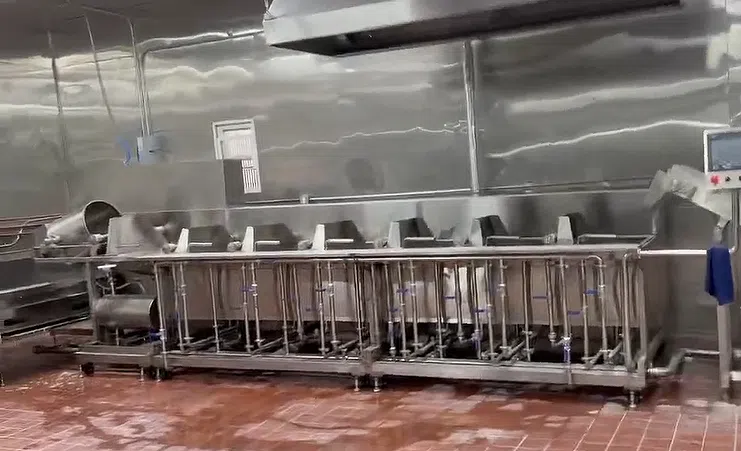
2. The Heart of the Line: 6-Stage Automated Boiling & Cooling
The front section of the line features a continuous Automatic Turnover Boiling Machine. This system is engineered for Standardized Production, where the residence time in each pot is digitally pre-set.
- The 3-2-1 Sequence: The line consists of 6 mesh-sieve pots: 3 Boiling Pots for precise starch setting, 2 Ambient Cooling Pots for temperature reduction, and 1 Ice Water Pot for “thermal shock” to lock in the “Al Dente” chewiness.
- Negative Pressure Dewatering: Post-cooling, the noodles enter a specialized Negative Pressure Suction Unit. By applying a vacuum, we strip away excess surface moisture without damaging the noodle structure—a critical step for shelf-life stability. It can be 2 to get more water away.
3. Tailoring Moisture Dynamics: Fresh vs. Frozen Logistics
A key highlight of this project is the line’s ability to adapt to two distinct preservation philosophies, dictated by how the product reaches the consumer.
Category A: Industrial Cold-Chain (The “Flash-Freeze” Strategy)
For retail packs like 100g or 200g destined for the freezer, the engineering focus shifts to cell-structure preservation.
- The 3-2-1 Shock: These noodles undergo a full ice-water bath to instantly set the starch.
- Zero-Thaw Preparation: Our Standardized Production ensures these noodles are flash-frozen at peak texture. For the end-user, these noodles must transition directly from freezer to boiling water. Avoiding the thawing stage prevents “moisture re-absorption,” ensuring the Al Dente quality remains intact until the moment of consumption.

Category B: Fresh Daily Distribution (The “Air-Dry” Strategy)
For products like Wuhan Hot Dry Noodles or Sichuan Cold Noodles, which are delivered daily to restaurants or retail, the goal is to prevent moisture from migrating back into the core.
- The No-Chilling Logic: After boiling, we skip the cold-water bath to utilize the noodles’ residual heat for evaporation.
- Forced Evaporation: On the finishing wing, two sets of loosening shafts and 5 high-velocity fans rapidly strip away surface moisture. This creates a “dry surface” that prevents the noodles from becoming soggy during same-day transit, maintaining that signature firm texture.


4. Integrated Automation & Flavor Integrity
This Custom Noodle Production Line demonstrates that high-capacity automation is a tool for flavor precision:
- Automated Oiling: A rotary drum ensures a microscopic, uniform oil coating, essential for preventing clumping in both fresh and frozen formats.
- Negative Pressure Dewatering: This vacuum-assisted stage is the “mechanical bridge” that allows for micron-level control over final moisture content, regardless of the variety.
FAQ: RTE Noodle Engineering
📌 Let’s Assist You
Turn Your Space into a High-Output Powerhouse. Whether you have a compact square workshop or a sprawling industrial floor, NoodleMachinePro designs the workflow that fits.
Email directly: info@NoodleMachinePro.com


Talk to Zhou on Wechat
Scan the code to add
Or, if you prefer, simply fill out our Contact Form and tell us your production goals.
We’ll get back to you with a tailored recommendation within 24 hours.


