Engineering a Scalable Noodle Production Line: Future-Proofing Capacity via Modular Architecture
Introduction
For industrial noodle manufacturers, purchasing an automated line is a major capital investment designed for a 10-to-15-year lifecycle. However, a common strategic failure is selecting a line based only on current sales volume. When market demand doubles, many factories discover their “standard” line cannot be expanded, forcing them to scrap perfectly functional machinery.
True future-proofing requires a Scalable Noodle Production Line engineered with a heavy-duty infrastructure and Modular Common-Frame Architecture from day one.
1. The Hard Constraints: Width and Batch Capacity Determine Your Destiny
In noodle engineering, certain parameters are structural and cannot be upgraded later. If your starting configuration utilizes a 50kg dough mixer and 300mm roll widths, scaling up to an 600-650 kg/h output in the future is mathematically and physically impossible.
A truly scalable line requires an upfront investment in the ultimate capacity chassis:
- The Mixing Baseline: Implementing a 125kg/batch Conventional Dough Mixers system from the beginning. This ensures the line can feed high-throughput processing as demand grows.
- The 440mm Standard: Setting the roller width at 440mm at Phase 1. Roll width dictates the volume threshold of the dough sheet; starting with 440mm ensures the physical runway for future mass-volume output is already secured.

2. The Expansion Logic: Adding “Workers” to the Sheeting Line
The foundational logic of expanding capacity is increasing the number of rolling stages. Think of it like adding workers to an assembly line to boost output.
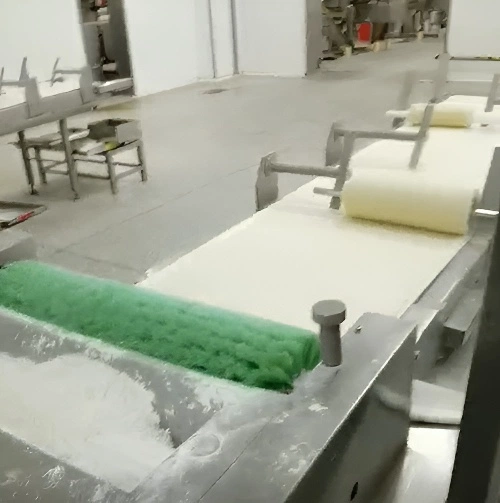
In a modular line, the expansion area is pre-determined during the initial factory layout design. Engineers reserve strategic physical space in the mid-section—specifically between the primary compounding rollers and the final thinning rollers. When market demand increases, 2 to 3 additional sets of rollers can be inserted directly into these pre-calculated locations without disrupting the overall line geometry or violating the R-C-R Noodle Processing Logic.

3. Modular Integration via Quick-Connect Design
The technical feasibility of mid-line expansion depends entirely on mechanical and electrical isolation. Because each set of Rollers is engineered as an independent, self-contained module, the integration process is seamless:
- Mechanical Docking: The independent roller units drop precisely into the pre-drilled, pre-aligned slots on the heavy-duty common frame.
- Quick-Connect Interfaces: All connections—including mechanical drive couplings, heavy-duty electrical power, and control circuit wiring (PLC/bus systems)—utilize industrial quick-connect (plug-and-play) designs.
This modular approach ensures that adding 2 to 3 stages of rollers requires minimal downtime, transforming what used to be a major factory overhaul into a routine field installation.

4. Protecting the Gluten Network at High Speeds
Why is adding roller stages the only correct way to scale? If a factory attempts to double output simply by speeding up a 5-stage line, the dough is forced through aggressive reduction steps too quickly. This destroys the Gluten Network and locks micro-voids into the sheet.
By adding 2 to 3 sets of intermediate rollers, the line maintains a gradual, stress-relaxed reduction process. This continuous Multi-Stage Rolling action ensures the dough receives ample time for lateral air expulsion and proper protein cross-linking, delivering the firm “bite” and soup integrity expected of premium industrial noodles.

Engineering FAQ: Future-Proofing Capital Investment
📌 Let’s Assist You
Plan for Growth, Not Just Production. Don’t build into a corner. Let our team engineer a scalable production blueprint aligned with your 5-year growth strategy.
Email directly: info@NoodleMachinePro.com


Talk to Zhou on Wechat
Scan the code to add
Or, if you prefer, simply fill out our Contact Form and tell us your production goals.
We’ll get back to you with a tailored recommendation within 24 hours.