
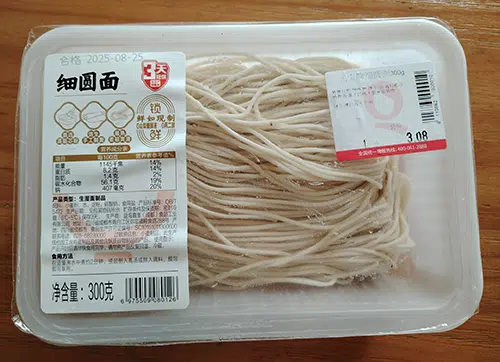
High-Quality Additive-Free Noodle Production: An Engineering Approach
Introduction
In the modern food industry, the “Clean Label” movement is no longer a niche—it is a global standard. For a [Noodle Factory], removing traditional additives like phosphates or thickeners presents a critical challenge: How do you achieve a resilient “Snap” using only flour, water, and salt?
The answer is not found in complex chemistry, but in Mechanical Gluten Reinforcement. By utilizing standard mixing to replicate traditional hand-kneading and optimizing the R-C-R (Resting-Compounding-Resting) Logic↗ and gradual reduction thinning↗, you can achieve superior structural integrity through pure physics.
1. The Mixing Stage: Replicating the Artisan’s Touch
To produce high-quality noodles without additives, the mixing stage must mimic the gentle yet thorough hydration of manual craft.
- Low-Speed Atmospheric Mixing: Unlike the forced hydration of vacuum systems, conventional dough mixer use low-speed to disperse moisture naturally. This allows the wheat protein to absorb water at a steady pace, creating a more “authentic” and layered Gluten Network that closely resembles handmade dough.
- The “Hand-Kneaded” Texture: By avoiding the hyper-dense structure of vacuum mixing, standard mixing preserves the traditional mouthfeel and pore structure of the noodle, which is essential for premium Japanese Ramen↗ and Chinese fresh noodles↗.

2. The R-C-R Logic: Physical Cross-Linking
In the absence of additives, the Resting↗ stages become the “active ingredients” of your process.
- Resting 1 (Hydration Stability): Without chemical dispersants, this initial rest allows moisture to stabilize across the dough granules naturally.
- Compounding (The Mechanical Bond): Through Closed-Loop Lamination, we fold and press the dough belt multiple times. This action physically weaves the protein fibers together, creating a robust internal matrix that doesn’t require chemical binders.
- Resting 2 (Stress Relaxation): This stage is non-negotiable for additive-free dough. It allows the internal tension to relax, ensuring the dough belt remains elastic and doesn’t fracture during the thinning process.
3. Gradual Reduction Rolling: Protecting the Protein
Additive-free dough is “honest”—it shows damage immediately. If you force the dough through a high-reduction gap, the gluten network will fracture, resulting in “mushy” noodles when boiled.
- The 30% Rule: By never reducing the thickness by more than 30% per pass, we preserve the natural elasticity of the wheat. This gradual thinning ensures the Al Dente texture is locked into the structure, providing the “tug” that consumers crave without needing gums or stabilizers.
4. Precision Cutting: Preventing Surface Damage
The final quality is often lost at the very last second. A dull or poorly calibrated Slitter can tear the edges of additive-free noodles, leading to starch leakage during boiling. Our precision-engineered cutting heads ensure a clean, “sealed” edge, which is vital for maintaining the clarity of the cooking water and the integrity of the noodle.
5. Technical Summary: Chemistry vs. Engineering
| Desired Trait | Additive-Based Method | NoodleMachinePro Engineering |
| Bouncy Texture | Phosphates / Guar Gum | Closed-Loop Lamination (R-C-R) |
| Authentic Mouthfeel | Emulsifiers | Low-Speed Atmospheric Mixing |
| Boiling Stability | Modified Starch | Physical Gluten Weaving & 30% Rule |
| Clean Label Appeal | Synthetic Binders | 100% Mechanical Strength |
6. What is White Label and Market Choice?
In today’s market, white-label food production, including noodles, is increasingly shaped by consumer preferences. Retailers and food brands seek products that align with “clean label” values: minimal ingredients, no artificial additives, and authentic quality. By offering additive-free, process-driven noodles, producers can differentiate themselves, strengthen trust, and access premium price segments.
Frequently Asked Questions
📌 Let’s Assist You
Pure Ingredients. Powerful Engineering. Transition to Clean Label production with confidence. Our R-C-R optimized systems are designed to give you the texture your customers love, using only the power of professional engineering.
Email directly: info@NoodleMachinePro.com


Talk to Zhou on Wechat
Scan the code to add
Or, if you prefer, simply fill out our Contact Form and tell us your production goals.
We’ll get back to you with a tailored recommendation within 24 hours.


